
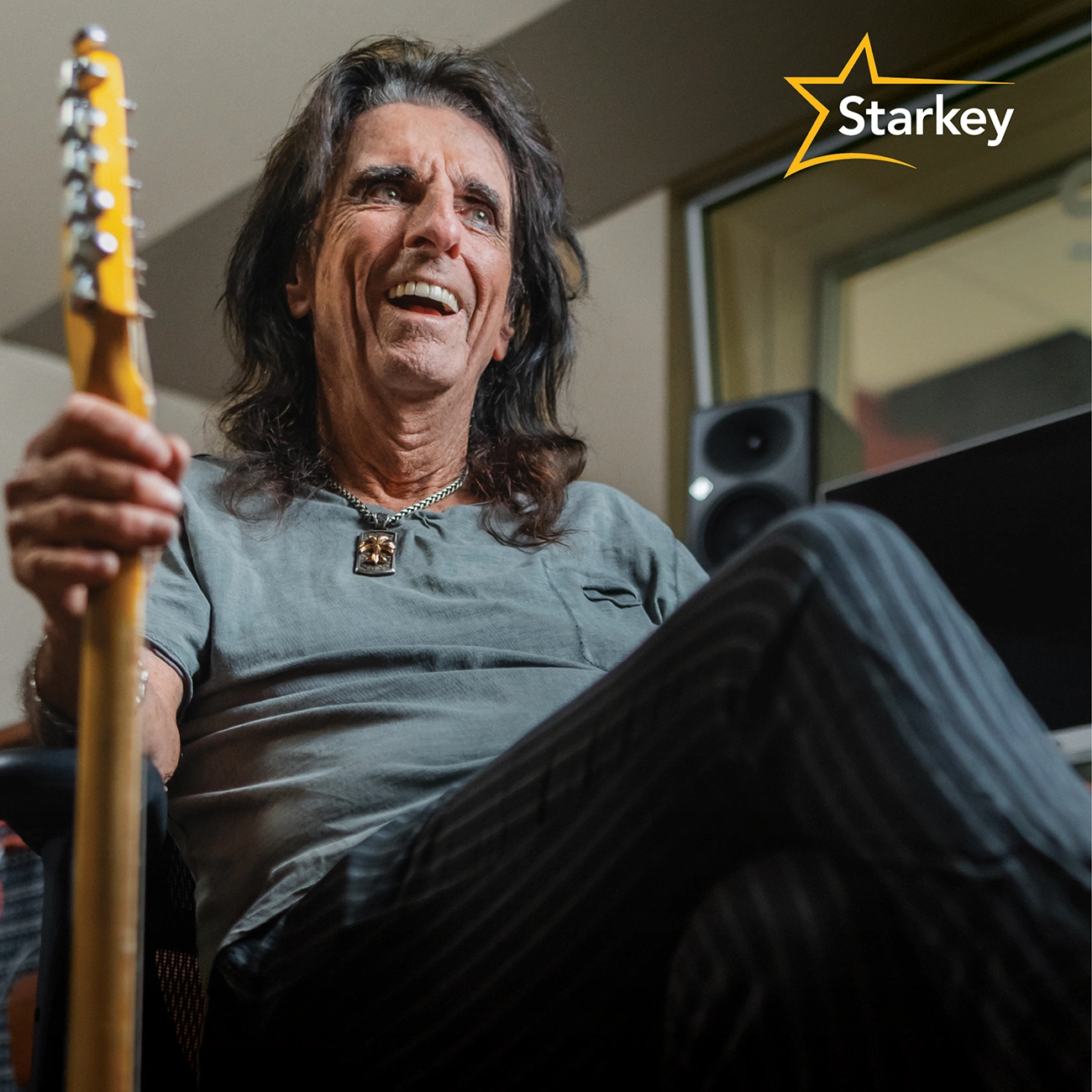
We all know musical legend Alice Cooper for his electrifying stage performances, raspy vocals, and unwavering impact on the world of rock-and-roll. But did you know the Godfather of Shock Rock is also an advocate for hearing health?
With over six decades of music-making under his belt, Cooper knows better than anyone how loud sounds can affect your hearing. On a podcast episode of Starkey Sound Bites with Dave Fabry, Alice Cooper shares his hearing loss journey, including how hearing aids improved his quality of life and career as a musician. Read on to learn more.
Alice Cooper: Rockstar and Hearing Health Advocate
In 1964, Alice Cooper started a band with a few friends from his high school track team. Little did he know, this passion project would eventually sell over 50 million records and take him touring all over the globe.
With theatrical stage performances, outlandish props, and an electrifying hard rock sound, they don’t call Alice Cooper the “Godfather of Shock Rock” for nothing. Since forming, the band has produced countless hits like “No More Mr. Nice Guy,” “School’s Out,” “Poison,” and many more.
However, after over 60 years of performing sold-out rock concerts, all that loud music inevitably took a toll on his ears. So today, legendary front man Alice Cooper plays another important role: an advocate for hearing health.
Alice Cooper’s Experience with Hearing Loss
Rock-and-roll has always been about pushing boundaries, cranking up the volume, feeling the energy of the crowd, and delivering exhilarating performances. But for legendary musicians like Alice Cooper, the same high-decibel lifestyle that fuels their careers can also take a toll. After decades on stage, Cooper is now confronting a reality that many musicians face: hearing loss.
He first noticed his hearing loss when it started getting difficult to understand TV dialogue. When he turned up the volume to hear better, his wife would point out how loud it was.
“I’d be watching TV and I’m going, ‘I’m only picking up half of what they’re saying,’” Cooper explained.
This experience is common for many people who develop hearing loss—which often starts as a slight struggle to hear dialogue on television, or missing parts of conversations.
The Moment of Change
Like many musicians, Cooper initially accepted hearing loss as an unavoidable part of his career. The deafening roar of concert speakers had become part of his daily life. “I just knew that night I was going to be blasted by 10 million decibels,” he admits, “so you kind of give up.”
But when Cooper finally had his hearing tested, the results were eye-opening.
“When they did check my hearing, I found out how much hearing I had lost. And then they put a hearing aid in and… I could hear perfectly again,” Cooper says. “It was just like being reborn again with your ears.”
Now, Alice Cooper proudly wears Starkey hearing aids every day. “It’s not a hearing aid as much as a clearing aid, because it took all that fuzz and focused it. I wear mine all the time.”
While on tour, he even brings backups just in case. “I have backups that I use. I always have four or five of them on the road.”
The Reality of Hearing Loss in the Music Industry
Noise-induced hearing loss (NIHL) is a common condition that affects nearly one in four adults in the U.S. alone.1 According to a study, musicians are nearly four times as likely to develop hearing loss at some point in their career.2
Our inner ears contain fragile hair cells that are essential for processing sound. However, exposure to loud noise can permanently damage these cells, which do not regenerate—leading to hearing loss.
Noise-induced hearing loss can happen to anyone, but musicians are especially at risk. Any sound at or above 70 dB can damage your hearing over time, and the average rock concert is around 94-110 dB. That’s a lot of noise for active musicians who are exposed to it constantly.
A Common Struggle for Rock Legends
For musicians, hearing is everything—it’s how they create, perform, and connect with their passion. But many don’t realize how important it is to protect their hearing until it’s too late.
Whether you’re on stage or in the studio, constant exposure to loud sounds causes permanent damage over time, making it difficult to hear conversations, music, or even daily sounds.
Alice Cooper knows he isn’t alone in this struggle. “I would say anybody that’s in this business and still around after 60, 50 years… We all have hearing problems.”
Advancements in Hearing Technology for Musicians
One of the biggest advancements in hearing protection for musicians has been the development of in-ear monitors (IEMs). But for artists who came up in the era of raw stage sound and turning your amps up to 11, these innovations simply weren’t available yet.
“We never took care of our hearing. We never wore in-ear [monitors] because they didn’t exist,” Cooper says. “The worse our hearing got, the more we kept turning the guitar up, which made it worse.”
In-ear monitors are electronic earplugs that both reduce external noise and enhance the sound from the instruments and vocals, streaming it directly to a musician’s ears. These devices help performers hear their music at a safe volume while also safeguarding their hearing while they are on stage.
Unfortunately for musical artists like Alice Cooper, IEMs weren’t invented until the mid 1980s. Thankfully, the hearing technology available today provides protection and clearer sound quality, allowing artists to perform without further damaging their hearing.
A Message from Alice Cooper to Those Hesitant to Address Hearing Loss
Hearing loss is a known issue in the music industry, yet many artists delay seeking help. This is why Cooper continues to advocate for hearing health, sharing his experience with friends and fellow musicians.
“I told Sammy Hagar. I said, ‘Sammy. These are the deal right here, and I’ll give you the number.’”
Cooper is passionate about encouraging others to take hearing loss seriously. “If they want to record, if they want to keep playing, they’ve got to come to grips,” he says. “If they make something that makes this better, why wouldn’t I go get it?”
Start Your Hearing Health Journey Today at Sandia Hearing Aid Centers
Alice Cooper’s journey with hearing loss is a testament to the importance of taking action. Regular hearing exams are essential to identify hearing loss early on and getting the care you deserve. If you or a loved one has experienced changes in your hearing, our specialists at Sandia Hearing Aid Centers in Albuquerque are here to help.
Take the first step towards protecting your auditory health and overall well-being by scheduling an appointment today.
References
- U.S. adults aged 20 to 69 years show signs of noise-induced hearing loss. (2017, February 7). NIDCD. https://www.nidcd.nih.gov/news/2017/us-adults-aged-20-69-years-show-signs-noise-induced-hearing-loss
- Professional musicians run almost four-fold risk of noise induced deafness. (2014, April 14). ScienceDaily. https://www.sciencedaily.com/releases/2014/04/140430192647.htm
- Learn about a safer way to rock and roll. (2019, May 22). It’s a Noisy Planet. Protect Their Hearing. https://www.noisyplanet.nidcd.nih.gov/have-you-heard/learn-about-a-safer-way-to-rock-and-roll